 VesselTill
Payments
Why integrated card payments can cost small shops more (and what to do instead)
Integrated card payments can cost a small shop more because the till and the card fees come as one package. You may pay a percentage of every card sale, a fixed fee per transaction and a monthly software or machine charge, and it is harder to switch. Keeping your till separate from your card machine lets you compare and change each one on its own.
What are integrated card payments?
Integrated card payments means your till (point of sale, or POS) and your card machine are connected. When you press charge, the till sends the amount to the card machine, and the result comes back by itself. Often the till and the card processing come from the same company, and the till only works with that company’s machines.
That is convenient. You do not type the amount twice, and every card sale is matched to a receipt automatically. The catch is that the convenience is usually paid for inside the card fees, the monthly fees, or both.
Where the costs come from
Every card payment has a cost, whichever till you use. What changes with a bundle is how the costs are packaged and how easily you can compare them. These are the usual parts:
- A percentage of each card sale. This is often called the merchant service fee or merchant discount rate. In South Africa, the Reserve Bank sets the interchange rates, which are one part of that fee. The fee itself is agreed between a shop and its card provider: in a 2021 statement about fuel retailers, the Reserve Bank said that it does not set the merchant service fee and that retailers can negotiate it with their bank.
- A fixed fee per transaction. Some plans add a fixed amount to every card sale on top of the percentage. On small sales, a fixed fee can matter more than the percentage.
- Monthly fees. Software subscriptions, account fees or a minimum monthly charge, whether you had a busy month or not.
- The card machine. Renting a machine monthly, or buying one that only works with that provider.
- Payout timing. Card money reaches your bank account later than cash reaches your drawer. How much later depends on the provider and your bank.
- Lock-in. If the till only works with one processor, changing to a cheaper card deal can mean changing your till, retraining staff and moving your product list.
None of these is wrong on its own. The problem is that a bundle makes it hard to see which part you are paying for, and hard to shop around for one part without giving up the other.
A worked example
The rates below are made up to show the sums. They are not any provider’s price. Use the rates from your own quotes.
Say a shop takes R50,000 a month by card, over 1,000 card sales (R50 on average).
| Monthly cost (example) | Bundle | Separate machine |
|---|---|---|
| Made-up rates | 2.75% + R0.50 per sale + R250 a month | 2.5%, no other fees |
| Percentage of R50,000 | R1,375 | R1,250 |
| Fixed fee × 1,000 sales | R500 | R0 |
| Monthly software fee | R250 | R0 |
| Total for the month | R2,125 | R1,250 |
In this example the difference is R875 a month, or R10,500 over a year. With different rates the answer could go the other way. That is the point: add up every line, not only the percentage. A rate that looks lower can cost more once a fixed fee lands on 1,000 small sales.
A quick way to check any quote: card sales × percentage + number of sales × fixed fee + monthly fees + machine rental.
The honest trade-off
Integrated payments do save real work, and for some shops that is worth paying for:
- The amount goes to the card machine by itself, so nobody types R150 as R15.
- Card sales and receipts match automatically at the end of the day.
- One company to call when something goes wrong.
A separate card machine costs you one extra step: you type the amount on the card machine, and tap Card on the till. At the end of the day you compare the till’s card total with the card machine’s total. For a busy shop with several tills and staff who change often, integration can be worth it. For a market stall, spaza, café or small shop, the extra step is usually small next to a monthly saving.
How VesselTill handles card payments
VesselTill is a free till, or POS system, that records how the customer paid. It does not process payments, so it has no processing fee, no subscription and no cut of your sales. You keep any card machine, QR or EFT provider you like, and you can change it whenever you find a better deal.
- Ring up the sale and tap Charge.
- Choose Card. The till says: “Complete the payment on your own card machine, then confirm below.”
- Take the payment on your card machine. If you want, type the reference from the slip.
- Tap Confirm & Receipt. The sale is saved, stock goes down and the receipt opens.
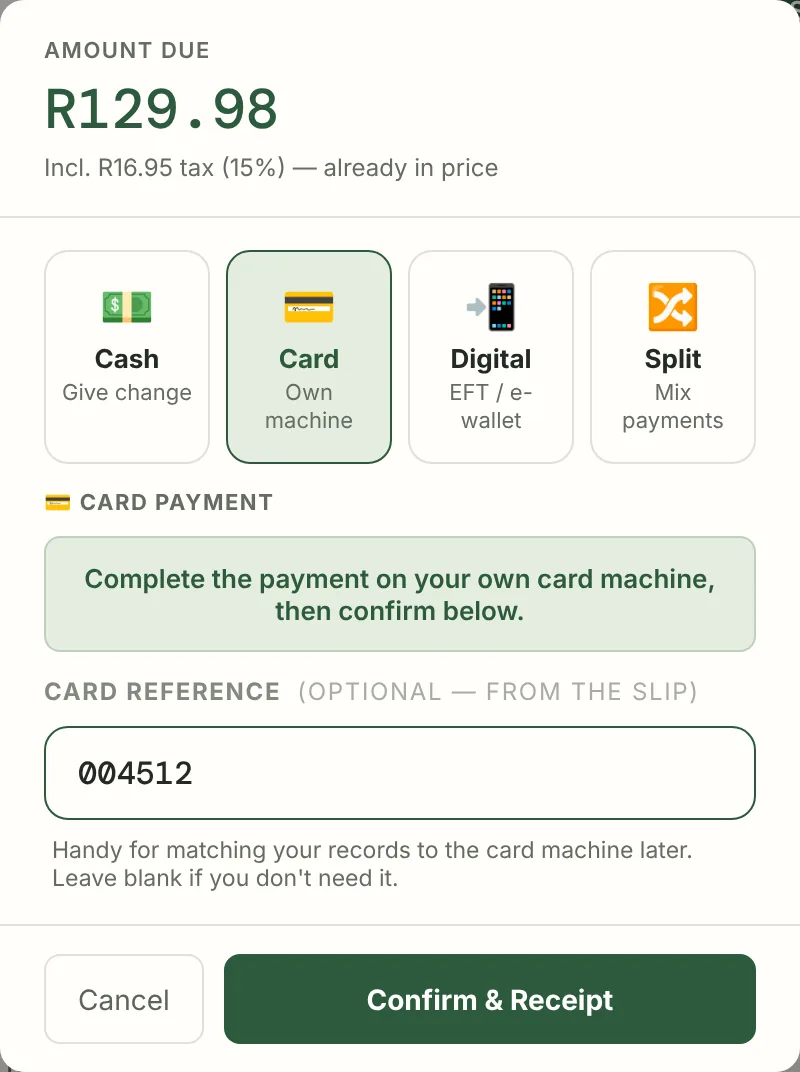
Your card provider’s fees still apply. VesselTill does not remove them; it just does not add its own. The End of Day report splits sales by payment method, so you can check the card total against your card machine’s report. There is more on this in the help guide on payments.
A checklist before you sign up for card payments
- What is the percentage per card sale, and is there a fixed fee per sale on top?
- Is there a monthly fee or a minimum monthly charge?
- Do you rent the card machine, or buy it? Does it work with other providers?
- How soon is the money paid into your bank account?
- Is there a contract period or a cancellation fee?
- Does the till only work with this provider’s payments?
- Can you still sell when the internet is down?
- Have you added up a normal month using your own sales, not the advert’s?
If you want to try the separate approach without spending anything, read how the free till app works, or how to keep selling with no internet.
Questions
Is VesselTill really free?
Yes. The till is free with no account, subscription, ads or VesselTill transaction fees. Products, stock, receipts, returns, reports and cash-up are included. Sync, for Google Drive backup and more devices, is an optional paid extra.
Does VesselTill take a percentage of my card sales?
No. VesselTill only records that the customer paid by card. It never handles the money, so it takes no percentage. Your card provider still charges its own fees.
Can I still accept card payments with VesselTill?
Yes. Take the payment on your own card machine, then choose Card in VesselTill and tap Confirm & Receipt. You can add the reference from the card slip if you want to match them later.
Which card machine works with VesselTill?
Any card machine you already use. Because VesselTill does not connect to the machine, it does not matter which provider you choose. The same goes for QR codes and EFT.
Why doesn’t VesselTill connect to card machines?
Keeping them separate means VesselTill never touches card details, keeps working offline, and lets you choose and change your card provider freely. The cost is one extra step per card sale: entering the amount on the card machine.
Sources
- South African Reserve Bank, Position paper on interchange in South Africa (02/2022, December 2022). The Reserve Bank determines and regulates interchange rates, and interchange is one part of the merchant service fee.
- South African Reserve Bank, Interchange policy paper. Definitions of interchange and the merchant service fee.
- IOL Business Report, 8 November 2021, quoting the Reserve Bank. For fuel retailers: the merchant service fee is not set by the Reserve Bank and can be negotiated with the acquiring bank.
- Checkout.com, “Interchange fees explained”, 14 November 2024. A card fee can be a percentage, a fixed amount per transaction, or both.
Checked on 13 November 2026.